

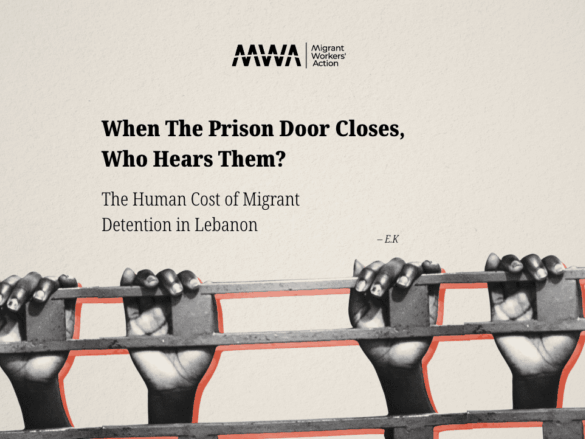
The human cost of migrant detention in Lebanon
There is something about visiting someone in detention that is difficult to explain.
The visits are brief.
But they are never light.
I walk in knowing I may have only a few minutes, and I walk out carrying pieces of people’s lives: a mother separated from her child, a daughter worrying about a sick father, a worker who came to Lebanon hoping to build something, a person who has spent years behind a locked door.
Sometimes they speak.
Sometimes they cry.
Sometimes they simply look at you and say:
“Please call my family.”
These are not stories I collected from a distance. They are cases I encountered through migrant community interventions in Lebanon. I have visited migrants in detention, listened to them and watched them cry.
The visits may be brief.
The suffering is not.
And every time I leave, one thought follows me:
I am walking out. They are not.
“Tell Mama I am coming home, but with nothing.”
One migrant asked me:
“Please call my family. Ask them to pray for me. Tell Mama I am coming back but with nothing. I made nothing out of Lebanon.”
There was an entire migration story inside those words.
She had come to Lebanon to work, earn money and support her family. Instead, she was sitting in detention, wondering how she would explain that she was coming home with nothing.
Another woman asked me to video-call her mother, who had hypertension. She wanted her mother to believe she was working in a mountainous village where there was no network. She wanted to save money. She wanted to go home.
She did not want her mother to know she had been arrested.
Then came the plea:
“Please don’t tell her I have been arrested.”
Imagine being behind a prison door while your sick mother waits thousands of kilometres away, believing you are somewhere working.
That is detention too.
Not only the cell. The silence.
“There is $70 in my brown bag.”
Another migrant did not ask me to rescue her.
She asked me to find her small brown bag.
Inside, she said, were $70.
She wanted the money sent to her father, who was undergoing cancer treatment.
Seventy dollars.
That was what she wanted recovered for him.
Even from inside detention, she was thinking about her father.
This is what statistics cannot show: a daughter worrying about cancer treatment, a family waiting for a phone call, someone behind bars still worrying about whether the people at home have enough.
The body may be imprisoned. The responsibility to family is not.
“Let them kill me too.”
One of the most painful cases I personally came across involved a migrant woman who has been imprisoned in a prison in Mount Lebanon for approximately seven years.
Seven years.
She had cared for an elderly woman. After the elderly woman died, she was imprisoned in connection with her death.
Seven years behind a prison door.
Seven years of birthdays missed. Seven years of family conversations she could not have.
Seven years of life continuing outside while hers remained suspended.
During one interaction, her despair was overwhelming.
She told me:
“Let them kill me too instead of this torture.”
I have not forgotten those words.
Seven years is not simply a number.
It is a child growing older without you.
A parent ageing.
A family learning to live without your presence.
Years that cannot be returned.
And there are other cases that raise an equally painful question: what happens when detention meets severe mental-health distress?
I received multiple calls from detainees about a migrant woman experiencing serious mental-health difficulties who had been restrained to a bed. Their calls were pleas for intervention from people who were themselves detained.
A person experiencing acute psychological distress needs safety, assessment, treatment and humane care.
When people who are themselves behind bars are calling from inside to ask for help for another detainee, who is listening?
When the people meant to protect her are watching
Another case brought to the attention of migrant-support actors involved a migrant woman experiencing significant mental-health distress who was beaten by an officer during an intervention, in the presence of social workers and a representative of her diplomatic mission.
The conduct of the consular representative present was also deeply concerning and was perceived as encouraging rather than de-escalating the confrontation.
That raises a question that should trouble all of us:
When a vulnerable person is being harmed, what should the people present to support or represent her be doing?
They should be protecting her, de-escalating the situation and ensuring appropriate care.
Mental-health vulnerability should call for greater protection not greater exposure to harm.
I have also encountered migrants who described being assaulted at different police stations while trying to obtain access to a phone.
A phone call can mean a lawyer.
An embassy.
A doctor.
A child’s voice.
For someone in detention, communication can be a lifeline.
When people outside have to provide the basics
I have encountered detainees whose basic needs depend on people outside the prison.
At a jail in the North, we take raw food to detainees so they can cook for themselves; otherwise, some may remain hungry. Community members and organizations also provide hygiene kits and other necessities.
These interventions matter.
But they raise a fundamental question:
Who is responsible for ensuring that a person deprived of liberty has adequate food, water and basic hygiene?
Humanitarian organizations can respond to suffering.
They should not have to become the system that prevents people from going hungry.
Charity can relieve suffering. It cannot replace responsibility.
A woman died
At the end of 2025, a migrant woman died in detention.
This is another case I encountered through migrant community interventions.
She became seriously ill. Her transfer to hospital was delayed. By the time she was taken for medical treatment, her condition had deteriorated severely.
She died.
I keep returning to one question:
Was the response fast enough?
When someone is seriously ill, time is not an administrative detail.
Time is life.
A detainee still gets sick. Still feels pain. Still needs a doctor. Still has a family waiting.
And still has a right to live.
Losing liberty must never mean losing the right to timely healthcare.
A mother should not have to wonder about her child
Some of the hardest cases I have encountered involve mothers.
One migrant mother has been separated from her baby for approximately a year.
Another has been separated from her child for around six months.
Their questions are heartbreaking:
How is my child?
Is my child eating?
Who is taking care of my child?
Does my child know why I am gone?
Imagine months without holding your own child, without knowing how they are growing, and without being able to reassure them that their mother has not abandoned them.
If there is no safeguarding reason preventing a mother and child from remaining together, why not consider appropriate shelter accommodation while legal proceedings continue?
Legal proceedings can continue.
Safeguarding can continue.
Immigration procedures can continue.
But childhood does not wait for a court date.
When freedom becomes a fundraiser
I have seen communities desperately raise money to help detained migrants leave.
A fine needs to be paid.
A ticket needs to be found.
Someone contributes $20. Someone contributes $50.
Well-wishers give what they can.
A person’s freedom can begin to depend on whether ordinary people can raise enough money.
Her release becomes a fundraiser.
There are also questions about departure costs. I have encountered cases where families were asked for money during the process of bringing detained migrants home, while in other cases immigration authorities or former employers covered exit or travel costs.
Families deserve clarity:
What exactly are they paying for? Who is responsible? Who receives the money? Is there an official receipt?
These are questions of transparency, not accusations against every diplomatic mission.
But one case I personally encountered is difficult to forget.
A migrant woman serving a life sentence reached out to her embassy for help.
The response from a consular staff member was:
“Don’t call me again.”
Imagine being imprisoned for life and reaching out to the institution representing your country abroad—only to be told not to call again.
When does diplomatic protection matter if not when a citizen is at her most powerless?
When the accused is also a survivor
I also came across the case of a migrant woman serving a life sentence after the death of a man who had raped her.
She had been raped by her male employer. When he later entered her room again, she fought back. He died.
Criminal responsibility must be determined through evidence and due process.
But justice must also be capable of seeing the whole human story.
Was her history of violence considered?
Was her psychological state considered?
Was the context in which she defended herself fully examined?
These questions do not diminish the seriousness of a death.
They ask whether the person before the court was seen only as an accused person—or also as a survivor.
Sometimes a person can be both.
We need answers, not silence
I am not writing this to condemn every police officer, prison employee, diplomat or humanitarian organization.
I am writing because the people I meet deserve answers.
How are detainees guaranteed adequate food, water and hygiene?
How is timely medical care provided?
What happens when someone experiences a mental-health crisis?
How are allegations of violence investigated?
How is prolonged detention reviewed?
What alternatives exist when keeping mothers and children together would be safe and appropriate?
How can detainees reliably contact lawyers, families and diplomatic missions?
And when families are asked to pay money to facilitate someone’s departure, where is the transparency?
When a detainee calls for help, someone should answer.
Not necessarily with the answer they want.
But with a response worthy of their humanity.
The person behind the number
Every time I leave a detention visit, I know I am walking out.
The person I visited is not.
I return to my life.
They return to the cell.
And sometimes, all I can carry out for them is a message:
“Please call my family.”
“Ask them to pray for me.”
“Tell Mama I am coming home.”
“Please find the $70 for my father.”
“Tell my family I am still alive.”
These requests sound small.
They are not.
They reveal what detention takes from people beyond freedom.
A daughter loses the ability to comfort her sick father.
A mother loses precious time with her child.
A family loses the truth.
A worker loses years.
A sick person risks losing her life.
A person in psychological distress risks losing hope.
And someone who has been waiting too long can begin to believe that nobody is listening.
But I have listened.
I have sat across from them.
I have watched them cry.
I have heard the things they are afraid to say to anyone else.
Those visits may be brief, but they are never insignificant.
Because when I walk out of that room, I carry their stories with me.
The migrant did not become less human when the prison door closed.
She did not stop being a mother.
He did not stop being someone’s son.
They did not stop having families waiting for them.
They did not stop feeling pain.
They did not stop needing hope.
They simply became harder for the outside world to hear.
So perhaps the question is not only what a migrant did to end up behind that door.
Perhaps we must ask something harder:
When the prison door closes, who hears them?
And if the answer is almost nobody,
then we have a much bigger problem than detention.
- The visitor.