

By Kanchana
In 2002, I left Sri Lanka with a suitcase, a broken heart, and one dream.
I was not chasing adventure. I was trying to save my family.
After my daughter's father left us, I became a single mother with no choice but to provide for my child alone. I wanted my daughter to continue her education, to have opportunities that I never had, and to build a small home where she could grow up with security and hope.
Like so many migrant women, I left my child not because I wanted to, but because I had to.
People often ask why mothers leave their children to work abroad.
The answer is simple.
We leave because love sometimes asks us to make impossible sacrifices.
When I arrived in Lebanon, I believed that hard work would lead to a better future. Instead, I entered a world I never expected.
The first family I worked for treated me as though I was less than human.
I was beaten.
My hair was cut without my permission.
I was refused food until hunger became unbearable, forcing me to search through a garbage bin for something to eat.
My passport was taken away, and with it, my freedom.
Those memories still live with me.
Many nights I cried alone, wondering if I would ever see my daughter again.
Whenever I spoke to her on the phone, I smiled through my tears. I wanted her to hear hope in my voice, not pain.
She never knew how often I cried after hanging up the phone.
But even in my darkest moments, I refused to let suffering define me.
Every difficult day had a purpose.
Every sacrifice was an investment in my daughter's future.
Over the years, I discovered something important.
Pain can either harden your heart or open it.
I chose to let it open mine.
Today, I still work as a domestic worker in Lebanon, and I am proud of honest work. There is dignity in every job done with integrity. No one should ever feel ashamed of earning a living through honest work.
Alongside my work, I now serve as the President of the Sri Lankan Women's Association in Lebanon.
This role is deeply personal to me because I know what it feels like to be afraid, alone, hungry, and unheard.
Whenever another domestic worker calls for help, I remember the woman I once was.
I support migrant workers by connecting them with organizations that can assist with legal issues and emergencies. I encourage women to participate in community activities and first-aid training because knowledge gives confidence, and community gives strength.
During the war in Lebanon, I joined volunteers in providing hot meals, drinking water, dry food, and hygiene supplies for displaced families. These were simple acts, but they reminded people that even in war, humanity still exists.
While serving others, I continue to support my own family back in Sri Lanka.
My elderly mother is unwell, and every month part of my salary goes home to help care for her.
Distance has never reduced my responsibilities.
If anything, it has made them greater.
People sometimes see migrant domestic workers only through the work we do.
They do not see the lives behind the uniform.
They do not see the mother counting the days until she can hug her child again.
They do not see the daughter worrying about her ageing parents from thousands of kilometres away.
They do not see the dreams we carry.
We are not machines.
We are not property.
We are not invisible.
We are mothers.
We are daughters.
We are caregivers.
We are leaders.
We are human beings.
My message to the world is simple.
Respect every worker.
Protect every woman.
Defend the dignity of every human being, regardless of nationality, race, or profession.
No woman should have to endure violence simply because she crossed a border to earn a living.
No mother should have to choose between feeding her children and staying beside them.
To my daughter —
If you ever read these words, I want you to know that every lonely night, every tear, every hardship, and every sacrifice was an expression of my love for you.
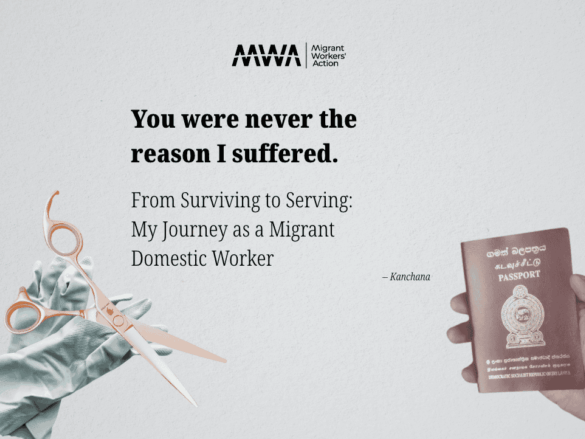
You were never the reason I suffered.