

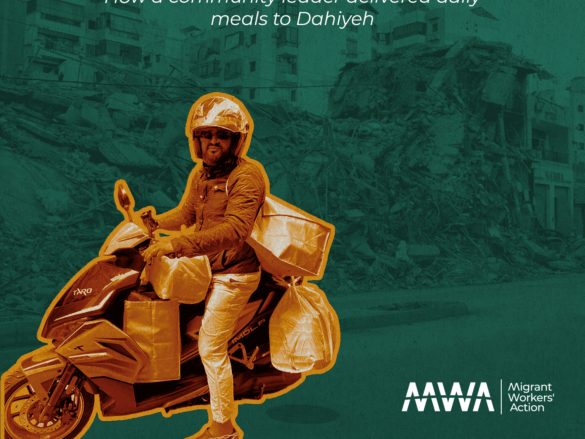
How a community leader delivered daily meals to Dahiyeh.
Ahsan is a community leader who has been in Lebanon since 2016. Ten years later, during the 2026 Israeli war on Lebanon, Ahsan was among the many leaders working day and night to provide emergency response to affected populations. Ahsan drove to Dahiyeh every single day, on a small motorbike, to deliver around 200-300 cooked meals to displaced migrant workers. Despite his bike being confiscated on two occasions, Ahsan managed to retrieve it and continue his incredible work.
On World Humanitarian Day 2026 we want to celebrate the work and commitment of migrant community leaders as first responders and frontline workers during the war on Lebanon.
This is him sharing his experience:
Today, I want to share my experience from the time when war was raging, when people were living in fear, hunger and uncertainty, and children were awakened by the sound of bullets, drones and airstrikes.
As a human being, I could not stay at home and do nothing. I am a father, a companion, a son, and above all, I am a human being in the name of my religion. My faith teaches me that we have a responsibility towards one another, and I could not turn away from the people around me. I still carry the memories from a few months ago, when the city that has now become my city was being destroyed.
I saw the hope of a mother who had lost her child slowly fading. I heard the cries of people who had lost their homes and had nowhere safe to go. I saw people searching for something as simple as a meal, a bottle of water, or a place where they could feel safe.
I also witnessed something else. I saw the happiness that a simple meal could bring.
Whenever I delivered food and water, I saw the relief on people's faces. Their eyes would light up. Children who had been frightened and silent would begin to laugh again. In those moments, I experienced a kind of happiness that is difficult to describe. As a humanitarian, I felt deeply grateful to be able to bring even a small moment of comfort to someone living through such a terrible time. I did this as a person devout in my religion and in the name of my religion.
When I think about those moments now, I still feel tears in the corners of my eyes. I think about how helpless people can become in the face of violence. I think about mothers who only want the best for their children, who want to give them a good meal, their favourite food, a toy, or simply the comfort and kindness that every child deserves.
I remember the heartbreaking cries of people who had lost everything. They wanted what all of us want: a safe place to live, a home for their families, and enough food for the day. I witnessed their pain, but I also witnessed their smiles when they received something as simple as a daily meal.
That difficult time taught me that people are there for one another. It taught me the meaning of solidarity and altruism. It gave me a profound sense of purpose and reminded me of the humanity we share.
There were moments when the sound of drones overhead and the fear of death made it difficult to continue. Every time I went out on the road, I knew there was a risk. But when I thought about my own children and my loved ones waiting for me in the relative safety of our home, I also thought about the children who were waiting for me to bring them a bowl of dhal and rice.
I kept thinking about one mother in particular. Whenever I brought food to her family, she would carefully take it and feed it to her children with such tenderness and affection. That image stayed with me. It reminded me why I was going out, even when I was afraid.
The sound of drones and airstrikes, and the fear of death, could not break my spirit. Instead, they strengthened my determination. I was a one-man-army on a bike.
That experience taught me to be human in a deeper way. It taught me that even in the middle of violence and destruction, we can choose to care for one another. It taught me that when we live not only for ourselves, but for the people around us, we find a different kind of strength.
During that time, I learned that humanitarian work is not only about providing food or water. It is about standing beside people when they feel forgotten. It is about reminding someone, even for a moment, that they are not alone. In the same way, although I was a one-man-army on a bike delivering food, I was not alone because the community kitchens, such as Tres Marias, were there beside me every single day to cook warm meals for the displaced migrants in Dahiyeh.