

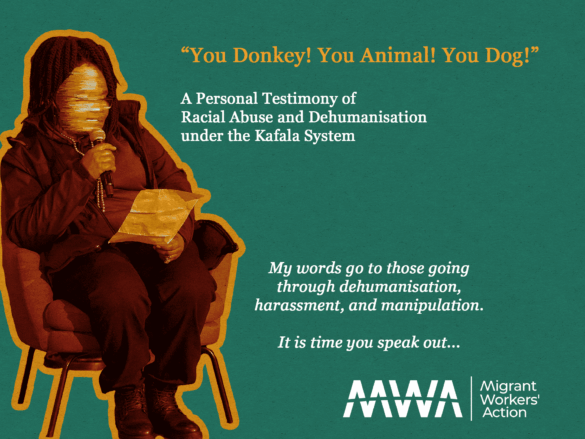
DISCRIMINATION IN CAPITAL LETTERS!
Dreams of a Better Future
At daybreak, as usual, I went to the main market to buy groceries and met an old school friend. I giggled happily, then went off. The following day, we met at the same market, and after discussing our struggles, she advised me to contact a certain company that hires people to work abroad. I decided to visit the agency to figure out what was best for me. Upon arrival, they were very welcoming and informed me of better working opportunities if I could manage to travel abroad. Without hesitation, I promised to go to the agency to register for travelling abroad. In my mind, I thought life would be better, just like we usually see on TV shows, beautiful, elegant, and classic. It didn’t take me long to figure out my passport and other travel documents.
On a faithful morning, I took off to the country's largest international airport. My heart was palpitating at the idea of living and working in a different country apart from my home; it really felt amazing. I never took a nap on the plane because I wanted to enjoy every bit of my journey.
The First Signs of Discrimination
When we reached a stopover in Abu Dhabi, as I was travelling from Nairobi to Beirut, things started to change in how we were being treated/handled by the security officers. We were instructed to queue on a specific line designated for housemaids, and little did we know at the time that it was intended for that purpose. The officer gathered all our passports and kept yelling out names to check in, and we somehow felt stranded because everyone else seemed to be settled with their journey except us, even though we had arrived on the same flight. The night fell without a drop of water or a plate of food. We shared the only bottle we had carried since we left the airport in our country. The weather was really bad because it was winter. We slept on the floor and on benches without any blankets, having a thousand questions in our minds about why no one could notice our presence or situation. It was weird anyway.
We took the second flight in the early morning hours, and the best we could do to comfort ourselves this whole time was to hold hands in prayer because somehow we felt things were not adding up, but we had to wait for the outcome. Luckily, we had a light meal on our second flight and managed to take a little nap. I personally started feeling discrimination according to what we encountered at the Abu Dhabi airport because of being segregated from other travellers, not being given instructions about our stay at the stopover, the confiscation of our passports, and being yelled at. This was so unusual.
Facing Reality upon Arrival
Finally, we arrived at Rafic Hariri Airport on a rainy day, with thunderstorms and lightning every now and then. We slept overnight at the airport. The night was chilly, and our heartbeats were down. No meals or blankets were offered to us; in fact, we slept on the floor. The worst scenario happened when we asked to be guided to the bathroom in English, being our only way of communication, and the security officers responded in Arabic: “Ma baaerif, shou am tahky? Ma baaerif!! Ruhe min hon!!! Ya aswad min wen jaye? Holi kello hamara…” [I don’t know what you're talking about? I don’t know! Move away from her!!! Hey, black one, where are you coming from? They are all donkeys…] We kept asking again and again until we came across a cleaner who understood English, and he directed us to the bathroom. It was such a horrible experience, for the first time in my life to come across people who could segregate you publicly, yell at the top of their voices, and the worst of it all, not to give directions to a bathroom. By the way, all our passports were confiscated for the second time. It was around 6:30 AM on the new day, and we just stared there like nomads, wondering what our fate could be. Within no time, the officer on duty arrived with a stack of passports and began yelling out names with incorrect pronunciations, as he was only familiar with Arabic. The employers started collecting girls one by one, and we were left behind, just a few of us.
False Promises, Shattered Dreams
To my knowledge, I had applied for a cleaning job at a certain company, only to be met by a lady and her son, who introduced themselves as my new employer. I was shocked because, according to my job description, I was hired to clean banks, schools, and hospitals, but that turned out not to be the case. At face value, I learned that I was tricked by my country's agency into a maid job, which had not crossed my mind because my former job involved packing in a specific industry for the export of farm produce.
I chose the cleaner job with the company because they offered a good salary, accommodation, and food, which made me feel I could save money to help my family and start my own business for financial stability. In my childhood, I dreamed of having a big business that I could use to support myself and my siblings, and help support the orphanage because they are less privileged. My dreams started shattering when my arrival in Lebanon did not meet my expectations, and worse still, the harsh weather, discrimination at the airport, and then the thought of being trafficked to do a house job abroad. I took off with the lady sponsor, “Kafeel”, to her house, and she went on explaining my duties immediately when we got to her house. I was scattered for some reason because it was not my chosen job, and we also had a language barrier; she barely knew any English words, so all translations were made by her son. I worked half-heartedly, hoping to meet the cleaning company in a week’s time, because I had told them I wasn’t ready to do household chores. She promised to connect me with the cleaning company and negotiate with them to hire another housekeeper.
“The New Hmara”
Days passed, and my heart sank with disbelief over my fate, having to do without meals except for tea and bread, “Arabic khebez,” [flatbread] every single day. When visitors came over to visit this family, the madam would describe me as the “New hmara or kalbe [donkey or dog] who came to clean their home”. The visitors would stare at me as if I were a wild animal, and in case they wanted to ask me questions, they were killed by the curiosity of asking in Arabic, “Ente fi douche bil hammam? Fi kahrba? Fi forn? Keyf tam3le al-akel? Fi fouweke?” [Are there showers in your bathrooms? Is there electricity? Are there ovens? How do you make food? Are there fruits?] I mean, the list was endless. My heart sank again on hearing such unfair words, and this was what I least expected from white people because to me, I felt we were all humans despite our different skin colour. I asked the Madam’s son about the meaning of “hmara and kalbe”, only to understand that “hmara” means a donkey and “kalbe” means a dog. I used to run to the bathroom and cry. I didn’t see the point in working or living with people who only saw me as an animal.
Daily Rituals of Humiliation
The madam used to mix excess Clorox with dishwashing soap whenever I was cleaning because she claimed that her house and utensils would turn black. It didn’t stop there; I was made to clean fruits and vegetables with dishwashing soap. Which, in my opinion, could be harmful to health due to its chemical composition. I personally grew up cleaning fruits and vegetables with vinegar and water, which is safer and a less hazardous alternative. Any time we went out with the family, I was supposed to be in my uniform, which was barely enough to shield me from the rain and the chilly weather. Everyone stared at me weirdly, and all I could hear was people murmuring in a language I didn’t understand: “Shoof sharmoota, aswad benet, mafi te3edo hon, ziho kelkon”. [Look at this bitch, a black girl, you can’t sit here, all of you move away.] As usual, I asked the little boy kindly to interpret for me, only to my surprise to learn that these people were referring to me as a slut, a black woman. I couldn’t believe my ears. My morale started to decline, and I often wondered how I could cope with such insults and unfriendly people on a daily basis. I felt disgusted. My hope to progress started fading away.
Speaking Out for Change
My words go to those going through dehumanisation, harassment, and manipulation. It is time you speak out about the pain, to start healing, and alleviate stress and other health issues born out of these unfair treatments.
As for those who feel capable of dehumanising and manipulating others, and who continue to see people through the cruel stereotypes that strip away their humanity, the time has come. It’s now. A moment to realise that the energy wasted on wrongdoing could instead be used to build a dignified society, and eventually make the world a better place to live in. Toxic cultures, poor communication, language barriers, and abuse of power all lead to an unhealthy society. Let the world hear this, and wake up from the illusion.